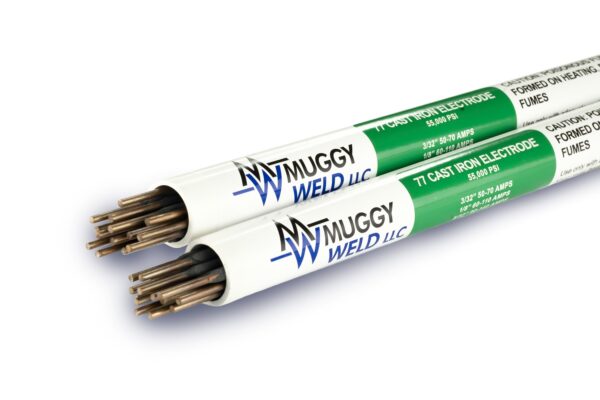
Its special tri-metal core has a high-current carrying capacity, and the specially designed coating converts the impurities of the base metal into slag instead of being trapped in the deposit. This means you spend less time on preparation, and more time making an effective repair (a valuable advantage for delicate tasks such as cast iron exhaust manifold welding). The high deposition rate creates an extremely narrow heat-affected zone, which minimizes the risk of distortion and results in easier machining.
Softer and more malleable than nickel rods, 77 cast iron welding rods have unique properties that allow the cast iron welds to stretch and elongate up to 300% more than other rods. This flexibility is invaluable, and you can trust 77 to deliver even when other rods might fail.
Kit Includes:
Mixed Diameter
- 3/32” Diameter: 2 rods, 12-inch length
- 1/8” Diameter: 2 rods lengths, 14-inch length
½ lb
- 3/32” Diameter: 14 rods, 12-inch length
- 1/8” Diameter: 7 rods lengths, 14-inch length
1 lb
- 3/32” Diameter: 28 rods, 12-inch length
- 1/8” Diameter: 14 rods, 14-inch length
5 lb
- 3/32” Diameter: 168 rods, 12-inch length
- 1/8” Diameter: 84 rods, 14-inch length
Shelf Life and Storage
Store 77 cast iron welding rods in a dry area at room temperature. Keep rods sealed in their original packaging or an airtight rod tube, to prevent moisture absorption. When stored properly, the electrodes maintain full performance and weld quality indefinitely.
How to Use 77 Cast Iron Welding Rod
- Prepare the Metal: Clean the repair area to remove dirt, oil, paint and grease using a grinder, wire brush, or suitable solvent.
- Choose the Correct Amperage: Use the recommended amperage range for the rod diameter (see tube). Start on the lower end and adjust as necessary for penetration.
- Short Arc Technique: Maintain a short arc length for better control, penetration, and bead appearance.
- Peen Each Bead: After each pass, lightly peen the weld while it’s still hot to relieve stress and prevent cracking.
- Allow to Cool Naturally: Never water cool or force cool, allow the weld to slowly air cool to prevent cracking.
For Heat-Affected Cast Iron: Begin with 72 Burnt Cast Iron Welding Rod to anchor into the parent metal, then overlay with 77 for a machinable, finished surface.
For Nodular, Ductile, or Malleable Cast Iron: Use 75 Cast Iron Welding Rod for proper expansion characteristics and a clean color match.
Common Applications
- Repairing cracked or broken engine blocks and heads
- Restoring cast iron machine bases, housings, and manifolds
- Welding gearboxes, pump housings, and compressors
- Fixing heavy castings and structural cast components
- Rebuilding cast iron tooling, vises, and frames
- Repairing oil-soaked or previously welded castings
What Our Customers Are Saying About 77
I used your 77 rods to repair a cast iron block this morning and I was very impressed.
It was a broken ear where the transmission bolts to the block. About 2″ x 1″. Completely snapped off during a wreck. The car only had 36,000 miles and the customer didn’t want to get a used engine with 60-80,000 miles. I didn’t take any pictures, wish I had because it came out even better than I thought it would have.
I was tempted to use TIG with those 77 rods but it was on a Saturday and I didn’t want to chance something going wrong. I tried calling you guys but I ended up stick welding it about 1/2″ at a time, peening the weld and letting it cool in between.
I have to tell you, that stuff laid in there beautifully (It almost looked like TIG). If it holds as good as it looks, I saved the customer a lot of money.
I used the stick process and they worked very well! They flowed in nicely and the welds looked great. It saved my customer from replacing the engine block. I highly recommend these rods, can’t wait to try them with TIG! — MCE Performance Murphy, Texas
It was amazing how nicely the 77 flowed with no splattering and popping, as experienced in prior cast iron welding repairs. We did not take the time to go for a real pretty weld, being more concerned with getting a good, deep penetration weld for maximum strength on this cast iron mounting bracket for the heavy sanding head for a Craftsman 6×48 belt sander in which this part was no longer available, thus rendering is useless until along comes Muggy Weld 77!! Now we will have a much used, valuable shop tool again available for regular use. Thank you kindly for your great neighborly customer service. — Jim Farley, General Manager www.wildfirerentalsandsales.com www.sosgeneralstore.com Founder: www.bsoscblog.com
In my welding career, I’ve done a fair bit of cast iron repair. After hearing about your product, and watching several videos online, I purchased a bunch of your 77 rods. I had a job modifying a steady rest, that included welding the head to a newly fabricated mild steel base. To say that I am extremely impressed and pleased with your product, is a definite understatement. It flows like warm butter. I wish I knew about your rods a long time ago. — Edward Joskow
I just welded a small block Chevy 400 engine with a broken ear on the starter mounts. The engine was sitting on a 3-wheel engine stand and fell over, breaking the mounts. I placed a mild steel bolt in the broken mounting hole, and built the whole corner back, then I removed the bolt and retapped the bolthole with no problem. It’s looking pretty good. Your 77 welding rods are better than anything I’ve tried in the past. — Bob Carpenter
I received the 77 Cast Iron Welding Rods today. I just fixed a BMW Mini Cooper block that swallowed two piston rods and busted the block. It took me about a half hour to mend the two holes, and I can’t even tell it was ever cracked open. Great stuff! Saved me a bunch of $$ Thanks! — Frankie Olthoff
Frequently Asked Questions
- Do I need to preheat the cast iron before using 77?
In most cases, no preheat is required. However, for very large or thick sections, preheating to around 400°F may help reduce stress.
- Can 77 be used on oil-soaked or contaminated cast iron?
No. For contaminated or burnt cast iron, use 72 Burnt Cast Iron Welding Rods first to anchor into the base, then overlay with 77.
- Can I use 77 on nodular or ductile cast iron?
For best results on nodular, ductile, or malleable cast irons, use 75 Nickel Rods.
Yes. 77 produces a machinable deposit that cuts cleanly without chipping, unlike hard nickel rods.
- What polarity should I use?
Use DC reverse polarity (electrode positive) for best results.
- Can 77 be used for multiple repairs on the same part?
Yes. 77 is ideal for repairing previously welded or brazed cast iron areas without cracking or porosity.
77 Cast Iron Welding Rod is the proven solution for strong, machinable, and crack-free welds on all types of cast iron. Its unique formulation eliminates the need for preheating in most cases, and produces smooth, dense, professional-quality welds every time.
For the best results on complex cast iron repairs, pair 77 with 72 for contaminated castings. Together, these rods provide the most comprehensive system for cast iron repair available.
California Proposition 65: WARNING: This product contains chemicals including [Nickel], which are known to the State of California to cause cancer. For more information, go to: https://www.p65warnings.ca.gov