

Every welder knows that heat control is everything. If you don’t know the thermal limits of your base metal, you’re setting yourself up for burn-throughs or weak joints. Understanding what the melting point of the most common metals is helps you choose the right filler, torch setting, and technique. We’re going to look into the specifics of several alloys you’ll likely encounter in the shop so you can approach your next repair with total confidence.
Aluminum
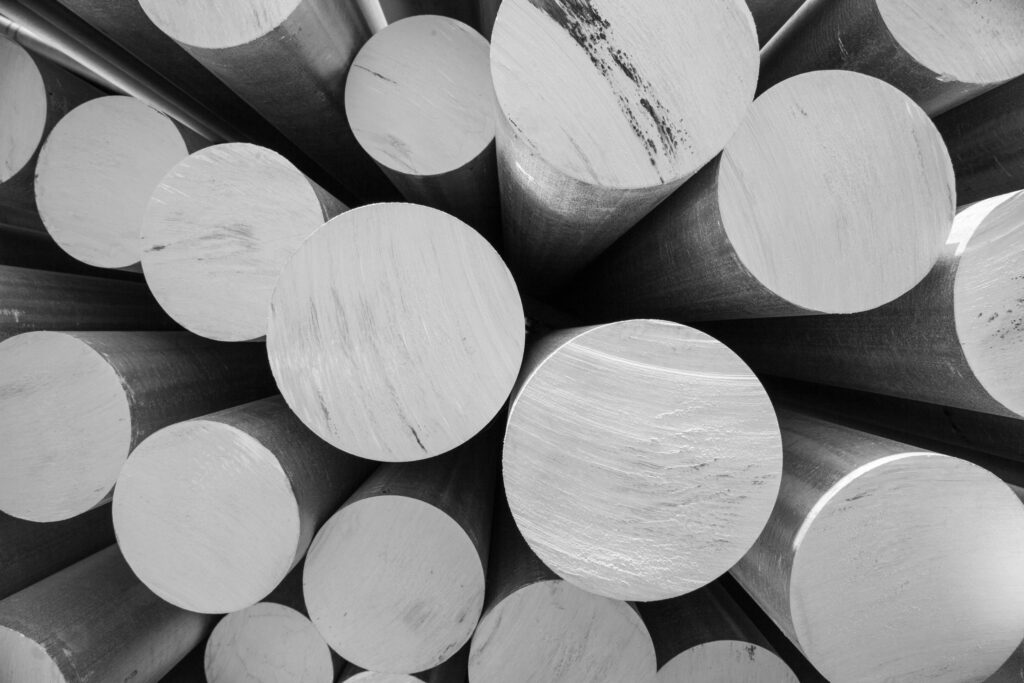
Several aluminum tubes with different diameters, some slightly scuffed, stacked on top of each other.
Aluminum appears everywhere from automotive parts to boat hulls because of its high strength-to-weight ratio. It’s a favorite among fabricators, but it presents unique challenges during the welding process.
Unlike steel, aluminum doesn’t change color as it gets hot. It stays silver until it suddenly liquefies and falls away. This lack of visual cues makes it tricky for beginners who rely on a glowing red color to judge heat input. You have to watch the wetness of the puddle closely rather than waiting for a color shift.
Aluminum’s Melting Point
Pure aluminum melts at approximately 1,220°F (660°C). But the aluminum oxide layer that forms on the surface melts at a much higher temperature, around 3,700°F (2,037°C).
You need to clean this oxide layer off before you start. If you don’t, you might overheat the base metal trying to penetrate the oxide, which leads to blowouts. Use a dedicated stainless steel wire brush to remove the oxide. Monitor your amperage carefully. Since aluminum conducts heat away quickly, you might need more heat at the start and less as the piece saturates with thermal energy.
Carbon Steel
Carbon steel is the most widely used metal in the world. You see it in structural beams, pipelines, and general fabrication projects. It’s forgiving and easy to work with compared to exotic alloys.
Most welders start their journey on mild steel because it behaves predictably under the arc. It holds heat well and gives you clear visual indicators as it gets hotter. The puddle is easy to manipulate, which helps you create consistent welds without fighting the material constantly.
Carbon Steel’s Melting Point
Carbon steel melts between 2,600°F and 2,800°F (1,425°C – 1,540°C). The exact number depends on the amount of carbon in the alloy. Higher carbon content lowers the melting point slightly but increases brittleness.
To successfully heat carbon steel, you need to maintain a steady travel speed to avoid putting too much heat into one spot. Excessive heat can warp the metal or alter its metallurgical properties.
Stainless Steel
Stainless steel is famous for its resistance to rust and corrosion. You’ll find it in commercial kitchens, medical equipment, and exhaust systems. It contains chromium, which creates a passive layer that protects the iron.
While it looks similar to carbon steel, it acts differently under heat. Stainless steel holds heat in the weld zone longer than carbon steel does. This property, known as low thermal conductivity, means heat builds up quickly and can cause significant warping if you’re not careful.
Stainless Steel’s Melting Point
The melting point for stainless steel sits roughly between 2,550°F and 2,790°F (1,400°C – 1,530°C). It’s slightly lower than carbon steel. Because it retains heat, you need roughly 30% less amperage than you would for carbon steel of the same thickness.
To reach these temperatures safely, keep your arc length short. Use chill bars or copper backing to pull heat away from the weld zone. This prevents the metal from overheating, which can burn out the chromium and ruin the corrosion resistance.
Copper
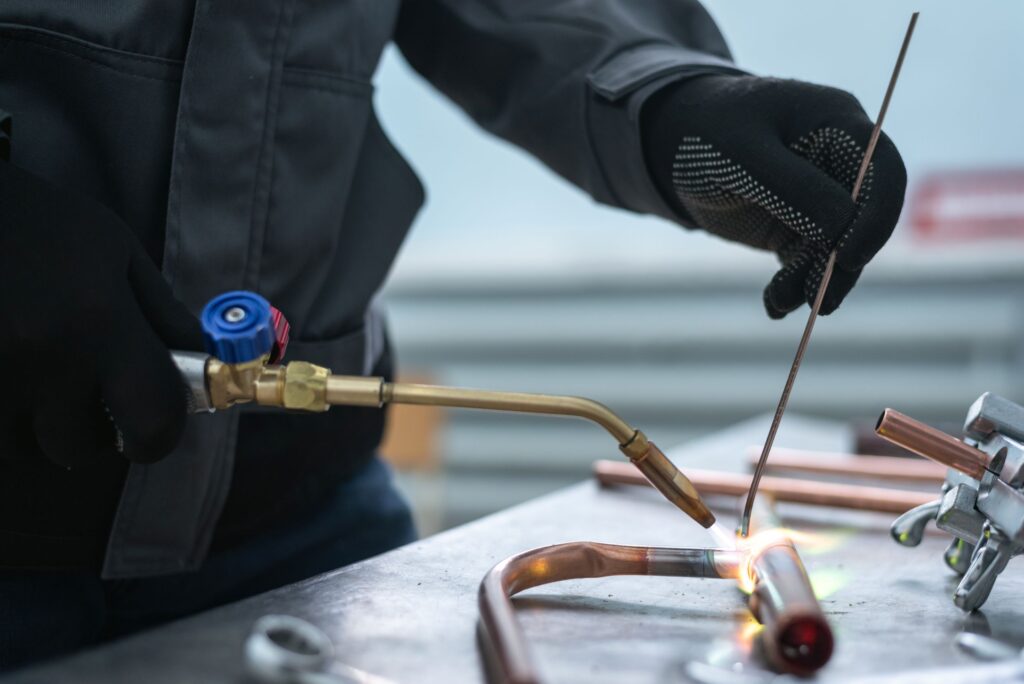
A person in a black jacket and gloves working with a torch and solder on a copper pipe placed on a worktable.
Copper is a unique metal. It conducts both heat and electricity extremely well. You’ll often see it in electrical components, plumbing, and artistic applications.
Welding copper requires a different mindset because the material sucks heat away from the weld puddle instantly. You might feel like you’re pouring heat into a bottomless pit. It often requires preheating to help the welding arc establish a puddle without requiring dangerous levels of amperage.
Copper’s Melting Point
Copper melts at 1,984°F (1,085°C). While this sounds lower than steel, the high thermal conductivity makes it harder to reach this temperature locally. The heat spreads through the entire part rapidly. To weld it safely, you often need to preheat the metal to somewhere between 200°F and 700°F depending on thickness. This reduces the thermal shock and helps you maintain a molten puddle.
Cast Iron
Cast iron is notorious for being difficult to weld. It has a high carbon content, which makes it hard, but it lacks the ductility of steel. If you try to weld it like mild steel, you’ll likely hear a “ping” sound as the metal cracks next to your weld as it cools. Many welders consider cast iron repair an art form.
Cast Iron’s Melting Point
Cast iron has a melting point around 2,200°F (1,205°C), which is surprisingly lower than steel. The danger here isn’t reaching the melting point but managing the thermal cycle.
You need to preheat the entire casting slowly and evenly. Once you finish welding, you have to let it cool very slowly. Some welders bury the part in sand or wrap it in welding blankets to retard the cooling process. This prevents thermal stress from cracking the heat-affected zone.
Titanium
Titanium offers an incredible strength-to-weight ratio and excellent corrosion resistance. Aerospace and high-performance automotive industries rely on it heavily. It’s a reactive metal that readily interacts with oxygen, nitrogen, and hydrogen at high temperature. If these elements get into the weld pool, the metal becomes brittle and useless. You need a rigorous shielding gas setup to get good results. It’s expensive, so mistakes are costly.
Titanium’s Melting Point
Titanium melts at a high 3,034°F (1,668°C). This is hotter than steel. The main concern here is protecting the hot metal from the air. You need to keep the weld zone shielded with argon until the temperature drops below 800°F. At this point, the metal is no longer reactive enough to absorb oxygen or nitrogen, which prevents the weld from becoming brittle and contaminated.
Stock Up and Start Welding
Knowing your numbers is half the battle. Once you understand what the melting point of the most common metals implies for your setup, you can adjust your torch and technique to match. Whether you’re fusing aluminum siding or repairing a cast iron manifold, respecting the heat limits of your material keeps your welds strong and your projects successful.
Need supplies for your next maintenance welding project? Muggy Weld is a welding supplies store that carries affordable, high-quality alloys and electrodes. Stock up on what you need so you can tackle that broken exhaust manifold, fix the aluminum boat leak, or create that custom gate you’ve been planning. Get the right gear and get burning.