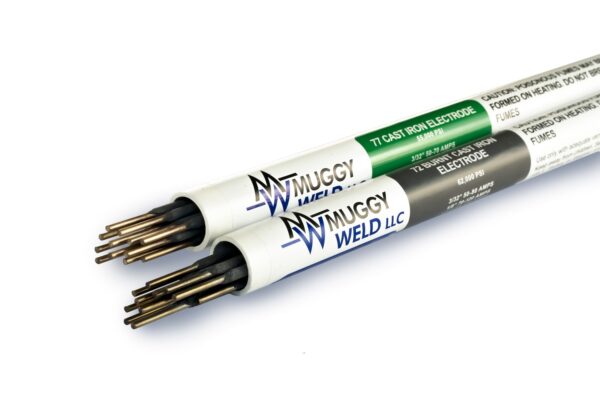
The Muggy Weld Cast Iron Repair Kit provides everything you need to repair cracked, burnt, or contaminated cast iron quickly and permanently. Designed for both professionals and hobbyists, this kit combines 72 and 77 welding rods to deliver strong, clean, and reliable results on cast iron engine blocks, exhaust manifolds, machine bases, heavy equipment, and other critical components.
Includes both 72 and 777 electrodes for complete cast iron welding and repair.
72 rod anchors into burnt, contaminated, or oil-soaked castings, while 77 finishes the job with a smooth, strong, machinable overlay.
In most cases, the repair can be performed without preheating, saving time and avoiding stress on the casting.
Delivers dense, durable welds with excellent ductility.
The finished weld stretches under stress without cracking.
Works for automotive, industrial, agricultural, and general machine repairs.
Whether you’re an experienced welder or new to cast iron repair, this kit simplifies the process while maintaining top-level results.
Cast Iron Repair Kit Includes
- One ½ lb tube of 72 Burnt Cast Iron Electrode, formulated to bond to burnt, contaminated, and oil-soaked cast iron
- One ½ lb tube of 77 Cast Iron Welding Rod, which creates a strong, porosity-free, machinable finish for gray cast iron
Available in diameters of 3/32” and 1/8”, to suit different repair types.
Shelf Life and Storage
Store in a dry area at room temperature. Keep rods sealed in their original packaging or an airtight rod tube, to prevent moisture absorption. When stored properly, the electrodes maintain full performance and weld quality indefinitely.
How to Use the Cast Iron Repair Kit
- Clean the Repair Area: Remove rust, grease, paint, and carbon buildup from the casting using a grinder or wire brush. A clean surface ensures the rods penetrate properly.
- Start the Weld with 72 Electrode: Use the 72 rod to anchor into burnt, contaminated, or oil-soaked cast iron. Maintain a short arc length and make short, controlled passes. The rod’s flux coating converts surface impurities into slag, and allows the alloy to fuse with the parent metal.
- Control Heat and Weld Length: Avoid excessive heat. Weld one to two inches at a time and alternate sides of the crack to distribute heat evenly. Overheating can cause stress and warping.
- Remove Slag Before Continuing: After each pass, chip and brush away the slag. Clean the surface before switching to the 77 rod.
- Finish with 77 Electrode: Apply 77 to complete the weld. This rod produces a smooth, porosity-free finish that can stretch up to 300% more than nickel rods, while resisting cracking caused by vibration or thermal expansion.
- Allow Slow Cooling: Let the part cool gradually in still air. Do not quench or expose it to drafts. Natural cooling prevents stress cracking and maintains weld integrity.
- Inspect and Blend: Once cooled, remove any slag and inspect your weld. Grind or blend if desired for appearance or fit. The finished repair is strong, permanent, and ready for service.
Common Applications
- Repairing cracked or burnt cast iron engine blocks and manifolds
- Restoring cast iron machine bases, housings, and tooling
- Fixing cast iron pumps, compressors, and structural cast components
- Rebuilding oil-soaked or previously welded castings
- General cast iron maintenance and fabrication in shops or industrial environments
What Our Customers Are Saying About the Cast Iron Repair Kit
Finally used the rod I bought from you a few years ago… GREAT stuff. I fixed a pump head that was cracked from leaving water in it before winter…. A little tough to build up a thin surface with, but once I got it started, I could do layer upon layer. I’ll get more when I try to fix my engine block. — Ronald Hoehn
Last week you overnighted me seven welding rods for use on cast iron. I have to share our experience with you.
We own a golf course and use old 4-wheel drive Jeep Wranglers to push our ball pickers, as they seem to hold up better than any other vehicles. Our oldest Jeep is a 1978 model – 25 years old. One of the teenagers who works for us overheated it and cracked the block in two places. Each crack about 4 inches long. We ordered a rebuilt motor ($1,200) for it and were eagerly awaiting its arrival. The motor supplier called us told us there were two motors for that model Jeep and asked us to check the numbers on the Jeep. To make a long story short, there were no motors to be had that would work in our old Jeep.
I asked our maintenance supervisor if he could weld the block and he told me he had never heard of anyone successfully welding a cast iron block as they just cracked on down as the weld was applied to them. (Same thing my Dad told me) We should just junk the Jeep.
Before I would give up on the Jeep, I went on the internet and searched for “cast iron welding”. Muggy Weld was the only name that came up. I read with great interest the information on welding cast iron with your rods. I asked my maintenance supervisor about trying your rods. He was skeptical, but since we had nothing to lose, we decided to try them.
We have been running the Jeep for four days now and the cracks seem to be holding just fine. Count us as satisfied customers of Muggy Weld. Thanks to you our Jeep is back at work (costing only $100 instead of $1,200) and running better than ever. –Donna Bearer, Golf Kountry
I recently purchased both your 72 & 77 welding rods and I have to say, with some hesitation. Ads never seem to be as good they say.
Well, I’m one of your converted. I’ve been working on an exhaust manifold from a 1930 Chrysler Imperial. While it took a couple of hours to make my way through the various cracks, it looks like your welding rods have done the trick. Thanks very much!! — Roger Morrow
We performed TIG on this heat register. When the customer tightened the bleeder valve, (NTP) it cracked the top portion of the heat register. Small cracks from the fracture started to show when we pressure tested, and when we were able to chase the cracks and get the old register back in working order for the customer. Great product! Know where to go for cast iron repair rod! — Andrew Martin, Midwest Welding and Machine
Frequently Asked Questions
- Do I need to preheat the casting?
No, preheating is not required for most repairs. For large or thick sections, preheating to around 400°F to reduce internal stress.
- Why are two different rods included?
72 bonds to burnt or contaminated cast iron, while 77 creates a clean, machinable finish. Together, they provide complete repair coverage.
- Can I use this kit on previously welded or brazed castings?
Yes, 72 anchors into contaminated areas, and 77 finishes with a strong, smooth surface.
Yes, 77 creates a machinable surface that can be drilled, tapped, or ground after cooling.
- What polarity should I use?
Use DC reverse polarity (electrode positive) for best results.
- Can I use this kit for nodular or ductile cast iron?
No. For nodular or ductile cast iron, use 75 Nickel-Iron Welding Rod for better ductility and color match.
The Cast Iron Repair Kit provides a complete, professional solution for repairing all types of cast iron. Use 72 to bond to burnt or contaminated areas and 77 to finish with a clean, machinable weld overlay.
Whether you’re working on automotive, industrial, or general machinery repairs, this cast iron repair kit delivers strong, reliable results with no preheat required. It’s the fastest, easiest way to restore cast iron components to full strength and function.
California Proposition 65: WARNING: This product contains chemicals including [Nickel], which are known to the State of California to cause cancer. For more information, go to: https://www.p65warnings.ca.gov