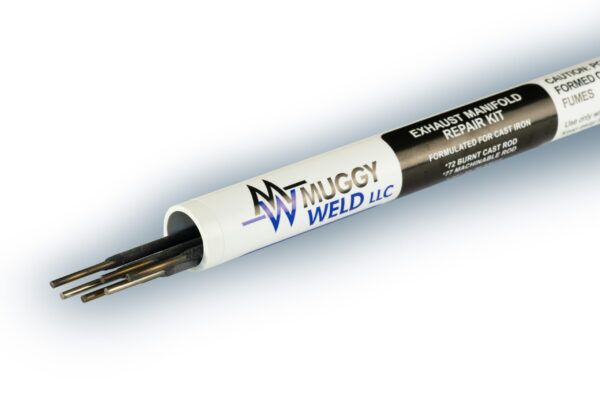
Introducing the Cast Iron Exhaust Manifold Repair Kit
The Muggy Weld Cast Iron Repair Kit saves you time and money on exhaust manifold repair. Using our repair kit, you can weld the manifold and make the repair without having to disassemble it first. If you can reach the crack, you can fix it while the manifold is still in place.
This kit provides an affordable alternative to repairing an exhaust manifold that could save you hundreds of dollars. There is no special heating or cooling required when using these rods, and no need to remove your exhaust manifold prior to making the repair. These qualities make this the ideal repair kit to have on the road with you if you’re trucking, RV-ing, or just traveling in general.
Why Choose the Cast Iron Exhaust Manifold Repair Kit
Repair in Place
No need to remove or disassemble the manifold when the crack is accessible
Burnt Cast Iron Capacity
Start with 72 rods to bond to heat-affected or contaminated cast iron surfaces
High-Performance Finish
Use 77 rods to complete the weld with strong, crack-resistant, porosity-free material
Efficient Welding
High-efficiency weld metal transfer prevents electrode overheating
No Special Preheat or Cooling Required
This kit is designed to save time and work with ease
Stretch Tolerance
The weld deposit stretches more than nickel welds, helping reduce cracking
Versatile Applications
Works on cars, RVs, trucks, and buses as a mobile repair solution
Learn How to Repair With Cast Iron Exhaust Manifold Repair Kit – Complete Video Series
Kit Includes
The Cast Iron Exhaust Manifold Repair Kit includes both 72 Burnt Cast Iron Electrodes and 77 Cast Iron Welding Rods. The quantity of each depends on the diameter you select:
Mixed Diameter
- 72 Electrode: 3/32″ Diameter: 1 rod, 14-inch length + 1/8″ Diameter: 1 rods, 14-inch length
- 77 Electrode: 3/32″ Diameter: 1 rod, 12-inch length + 1/8″ Diameter: 1 rods, 14-inch length
- 3/32” Diameter: 3 rods 77 electrode, 3 rods 72 electrode 14-inch length
- 1/8” Diameter: 2 rods 77 electrode, 2 rods 72 electrode 14-inch length
Shelf Life and Storage
Store in a dry area at room temperature. Keep rods sealed in their original packaging or an airtight rod tube, to prevent moisture absorption. When stored properly, the electrodes maintain full performance and weld quality indefinitely.
How to Use Cast Iron Exhaust Manifold Repair Kit
- Determine Accessibility: If you can reach the crack, you can repair in place without removing the manifold. This saves time and avoids the risk of breaking bolts or damaging gaskets.
- Clean the Repair Area: Begin by removing all grease, paint, rust etc from the cracked or damaged section of the manifold. A clean surface ensures a more effective bond.
- Anchor the Weld with 72 Burnt Cast Iron Electrode: Start the repair with 72 Burnt Cast Iron Rod. Strike an arc and maintain a short arc length to achieve proper penetration.
- Use Proper Technique and Temperature Control: Avoid long arcing or excessive heat buildup, which can distort the manifold. Instead, make small overlapping beads, allowing each to cool slightly before continuing. If you’re welding a long crack, weld and inch or two at a time and alternate ends of the crack to distribute heat evenly.
- Remove Slag Between Passes: After completing a short weld segment with 72, chip and brush the slag away before switching to the 77 rod. This ensures a clean bonding surface for the next layer.
- Overlay with 77 Electrode: Once the base layer with 72 is established, continue with 77 rod to complete the repair. The 77 rod provides a strong, porosity-free weld that resists cracking and can stretch up to 300% more than nickel rods.
- Control Cooling for Best Results: Allow the repaired manifold to cool slowly in still air. Do not blow air, fan-cool, or expose the parts to drafts. Fast cooling can cause cracking. The ideal cooling process is natural and gradual.
- Final Steps: When the manifold is fully cooled, remove remaining slag and inspect the weld. Grind or blend the repair if desired for appearance or fit, but machining is generally unnecessary.
- Reinstall or Test the Manifold: Once the repair is complete and cool, reinstall or run the engine to confirm there are no leaks. The finished weld will remain strong and flexible under repeated healing and cooling.
Common Applications
- Fixing cracked or leaking exhaust manifolds on cars, trucks, RVs and buses
- Repairing manifolds that have been damaged by excessive heat or thermal cycling
- On-the-Road Repairs to prevent breakdowns or to finish repairs without full manifold removal
What Our Customers Are Saying About Cast Iron Exhaust Manifold Repair Kit
I recently purchased both your 72 & 77 welding rods and I have to say, with some hesitation. Ads never seem to be as good they say.
Well, I’m one of your converted. I’ve been working on an exhaust manifold from a 1930 Chrysler Imperial. While it took a couple of hours to make my way through the various cracks, it looks like your welding rods have done the trick. Thanks very much !! — Roger Morrow
I just want to congratulate you on a superb product–that 72 and 77 electrode. I do antique restorations and I was working on a stove that was 140 years old. The internal components, meaning the fireback (which is cast iron) was split, worn, and burned through – it was ugly, and that’s an understatement.
I said “well, if your welding rod can put this back together (and you must understand I was repairing it not to use but to simply to send off to a foundry to have the parts re-cast), but as it is right now, I could probably use the damn thing!”
I’m just amazed that your rod, especially the 72, could arc weld it. You have to do it incrementally but that stuff really, really gets into that burnt cast iron. But like I said it’s an excellent product and I’ve never seen a welding rod perform quite like that. So keep up the good work guys and I definitely will consider you in the future for all my electrodes. Thanks again, and take care —Jim
Frequently Asked Questions
- Can I repair the manifold without removing it?
Yes, if the crack is reachable, you can use the kit without disassembly.
- Why use 2 different rods (72 & 77)?
72 bonds to dirty, burnt, or contaminated cast iron, 77 is used for a strong overlay that resists cracking.
- Do I need to preheat the manifold?
No special heating is required in most cases.
- What polarity should I use for the repair?
DC reverse polarity (electrode positive).
- Can I use this kit for nodular or ductile cast iron?
Use 75 Nickel Welding Rod for better nodular and ductile cast iron repairs.
The Cast Iron Exhaust Manifold Repair Kit provides a complete, reliable solution for repairing cracks in cast iron exhaust manifolds. Use 72 to anchor into burnt or contaminated areas, then finish with 77 for a durable, crack-resistant weld. Repair in place, skip removal, and get lasting results on a variety of vehicle types.
California Proposition 65: WARNING: This product contains chemicals including [Nickel], which are known to the State of California to cause cancer. For more information, go to https://www.P65Warnings.ca.gov