
Braze 3003 Aluminum Like a Pro
3003 aluminum turns up in more places than many people realize. This non-heat-treatable alloy is widely used for sheet metal, ductwork, chemical equipment, gas lines and tanks, refrigerator panels, heat exchangers, garage doors, and other aluminum parts. When one of those pieces cracks or needs to be joined, the repair method has to account for aluminum’s ability to shed heat quickly.
Super Alloy 5 can braze 3003 aluminum at a working temperature of 600°. In this application, two 3003 aluminum plates are joined with a trigger-start Bernzomatic propane torch, Super Alloy 5 rod, and its matching powder flux. The finished bond is rates at 30,000 PSI.
What is 3003 Aluminum?
3003 aluminum is a non-heat-treatable aluminum alloy. It uses range from ordinary sheet metal to parts that handle gas, chemicals, refrigeration, and heat transfer.
Those applications can produce many different repair situations. Some involve thin sheet, while others involve larger parts that absorb more torch heat. The size and mass of the workpiece should therefore help determine which torch you choose.
Choose a Torch That Can Maintain the Heat
Aluminum moves heat away from the work area quickly. A torch needs enough output to bring the parent metal to 600°F and keep it there long enough for Super Alloy 5 to flow.
A trigger-start Bernzomatic propane torch supplies enough heat for the 3003 aluminum plates used here. Oxyacetylene and oxy-MAPP can also be used for 3003 aluminum repairs.
The right torch will depend on the amount of aluminum involved. If the part pulls away heat faster than the torch can replace it, the filler rod will give you a clear sign that something needs to change.
Start with Super Alloy 5 Flux
Warm the end of the Super Alloy 5 rod, then dip it into the powder flux so a small amount sticks to the rod. Transfer that flux to the 3003 aluminum before adding filler.
The flux helps clean the parent metal while also acting as a temperature guide. As the aluminum reaches 600°F, the flux changes into a thing, watery liquid. That change marks the point when the filler rod should be applied. This visual cue is particularly helpful with aluminum because you can judge the temperature through the flux rather than waiting for a visible change in the parent metal.
Heat the 3003 Aluminum from Side to Side
Aim the torch at the parent aluminum rather than the filler rod. Move the flame from front to back and side to side so the heat spreads across the work area. Broad heating matters because aluminum can carry heat away from the joint at a high rate. A narrow flame held over the filler may melt the rod without bringing enough of the parent metal to working temperature.
Once the flux turns watery, touch the Super Alloy 5 rod to the heated aluminum. Add flux again as more filler is introduced. Using flux with each addition of rod helps increase bonding strength.
What if Super Alloy 5 Balls Up?
A ball of filler at the end of the rod means the parent aluminum has not reached the required working temperature.
Return the torch to the 3003 aluminum and spread the heat over a wider area. Wait until the flux liquefies and the rod begins to flow before moving farther down the joint. This makes the filler itself a useful troubleshooting tool. If it flows, the aluminum has enough heat. If it sits in a ball, put more heat into the base metal rather than trying to melt the rod with the flame.
Pull the Torch Away Once the Filler Flows
There is little reason to keep pouring heat into the aluminum after Super Alloy 5 starts moving. Once the filler begins to flow, pull the torch away quickly to reduce the chance of overheating the base metal.
This gives the process a natural rhythm. Warm the aluminum, watch the flux, add the rod, then back off the flame once the filler moves. Repeat that sequence as needed until the joint is complete.
Keep Moisture Out of the Flux Jar
Super Alloy 5 flux works best when it remains in powder form. If moisture gets into the jar, the flux can turn into a paste. It can still be used, but application becomes more difficult.
When using damp flux, watch it change back toward a powdery state as it heats and then becomes liquid as the aluminum reaches working temperature. Keeping the container capped immediately after use helps prevent moisture from entering the jar.
Finish the 3003 Aluminum Joints
Let the repaired aluminum cool, then wash away the remaining flux with warm water and a wire brush. The finished Super Alloy 5 bond can be bent, drilled, tapped, anodized, machined, threaded or plated. That gives you several options when the brazed part needs more fabrication or finishing before returning to use.
Let the Flux Set the Pace
The useful lesson with 3003 aluminum is easy to carry from one job to another. The part itself may be a refrigerator panel, heat exchanger, gas tank, or a simple piece of sheet metal, but the flux gives you the same 600°F signal each time.
Watch for that powder to become thin and watery, then add the filler. If the rod balls up, the aluminum needs more heat. If it starts flowing, back the flame away and let the alloy fill the joint. That makes the flux more than a cleaning aid. It becomes the temperature marker that guides the entire 3003 aluminum brazing process.
Disclaimers:
Please visit https://www.aws.org/Standards-and-Publications/Free-Resources/#YourResources prior to using our welding products, and adhere to all AWS welding safety guidelines.
Further product safety information is available at https://muggyweld.com/safety-guidelines
Muggy Weld LLC shall not be liable for any loss, injury, claim, liability, or damage of any kind resulting in any way from (a) your use of this Site, (b) any services or products obtained from this Site, (c) any errors in or omissions from this Site, (d) the unavailability or interruption of this Site or any features thereof, (e) any content contained on this Site.
SDS sheets available with purchase from MuggyWeld.com, upon request.
Update 6/14/26
Check Out These Products
-
Super Alloy 1 Low-Temperature Solder
Price range: $55.00 through $980.00350º F multi-metal solder joins pot metal and all white metals, in any combination🌡 Melting Temperature 350 / 177 ⇄︎ Bonding Strength 20000 psi, 137.89 MPa -
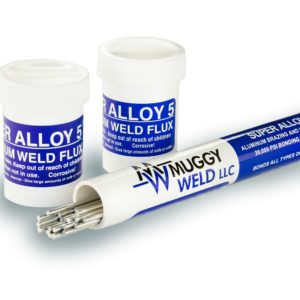
Super Alloy 5 Aluminum Welding and Brazing Rod
Price range: $55.00 through $980.00600°F aluminum welding, brazing, and soldering rod. Ideal for aluminum boat repair and cast aluminum.🌡 Melting Temperature 600 / 317 ⇄︎ Bonding Strength 30000 psi, 206.84 MPa -
Sale!

SSF-6 Silver Solder Rod: Flux-Coated SSF-6 56% Brazing Rod
Price range: $100.00 through $3,000.00High-Strength, 56% Silver Solder Rod🌡 Melting Temperature 1150 / 621 ⇄︎ Bonding Strength 70000 psi, 482.63 MPa 🔧︎ Sizes Available (in) 1/16 🔧︎ Sizes Available (mm) 1.58