
What is an intake manifold?
An intake manifold is a component of the engine responsible for supplying fresh air to the cylinders, where gas and air are combined to create engine horsepower. Many muscle car enthusiasts install premium aftermarket intake manifolds such as the Holley Street Dominator, in an effort to increase the air and fuel supply to the engine, thereby increasing engine performance. Premium intake manifold installation is a simple task that requires basic tools and rudimentary mechanical repair knowledge.
But what happens if you break the aluminum intake manifold during install?
Unfortunately, accidents happen. This Holley Street Dominator aluminum intake manifold was cracked from over tightening and required an immediate repair. Failure to weld the crack in the aluminum intake manifold will likely result in a decrease in power, due to the overabundance of air in the cylinders.
So how to braze weld an aluminum intake manifold?
For this aluminum intake manifold repair, we utilized an oxyacetylene torch and Super Alloy 5 aluminum weld braze and solder repair kit. Due to the large mass of aluminum, oxyacetylene or an oxygen fueled torch must be used (to heat the aluminum to proper working temperature)
Prepare the parent metal with a die grinder to open the crack, allowing for better penetration of the aluminum.
Next, use the torch to broadly heat the aluminum intake manifold for about 3 minutes. Super Alloy 5 will not flow if the aluminum is below 600°F, so be sure to take your time bringing the large mass of aluminum to temperature.
As the base metal begins to heat up, add flux to the crack in preparation of the weld.
Initially, the aluminum filler rod balled up, as you can see. If this happens, it’s an indication that the aluminum is not hot enough to flow the rod. The solution is to pull the rod away and continue to preheat the aluminum intake manifold until it reaches 600°F. Do not use the balled piece of rod, as it’s been chemically altered by the application of heat and will not perform the same as the filler rod.
When Super Alloy 5’s powder flux changes from powder to thin watery liquid, this indicates the aluminum has reached the proper working temperature. At this point, we painted the rod into the crack, using additional flux and the heat from the torch to flow the filler rod.
Another successful aluminum weld, made possible by high quality aluminum welding products.
Note: Please observe all AWS Safety & Health Guidelines when using Muggy Weld products.
Check Out These Products
-
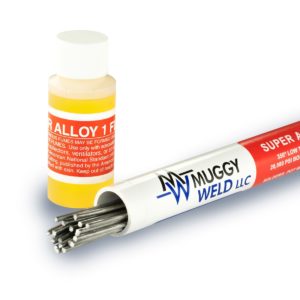
Super Alloy 1 Pot Metal Solder and Multi-Metal Solder
$69.00 – $109.00350º F multi-metal solder joins pot metal and all white metals, in any combination🌡 Melting Temperature 350 / 177 ⇄︎ Bonding Strength 20000 psi, 137.89 MPa -
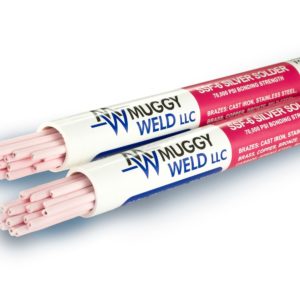
Silver Solder Rod: Flux-Coated SSF-6 56% Brazing Rod
$69.00 – $260.00High-Strength, 56% Silver Solder Rod🌡 Melting Temperature 1150 / 621 ⇄︎ Bonding Strength 70000 psi, 482.63 MPa 🔧︎ Sizes Available (in) 1/16 🔧︎ Sizes Available (mm) 1.58 -
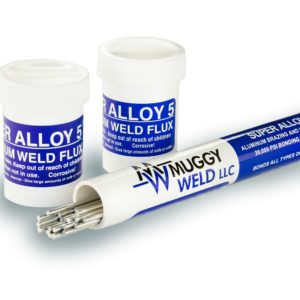
Super Alloy 5 Aluminum Welding and Brazing Rod
$69.00 – $109.00600°F aluminum welding, brazing, and soldering rod. Ideal for aluminum boat repair and cast aluminum.🌡 Melting Temperature 600 / 317 ⇄︎ Bonding Strength 30000 psi, 206.84 MPa