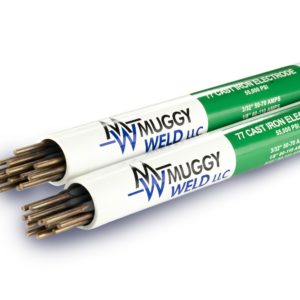
Repair a Broken Craftsman Cast Iron Bracket with 77 Electrode
Jim Farley’s Craftsman 6×48 belt sander was a valuable, frequently used shop tool until the cast iron mounting bracket supporting its heavy sanding head broke. Jim described the bracket as irreplaceable, leaving him with a perfectly useful machine he could no longer operate.
Rather than give up on the sander, Jim decided to repair the original casting with Muggy Weld 77 Cast Iron Welding Rod.
After completing the repair, he contacted Muggy Weld to share his experience and sent photos of the welded bracket. Having attempted cast iron repairs before, Jim was impressed by how smoothly the electrode handled compared with the rods he had previously used.
Jim Farley’s Experience Welding Cast Iron with 77
Cast iron can be challenging to weld because its relatively brittle structure makes it susceptible to cracking from the stresses created during heating and cooling. Jim was familiar with some of these difficulties from previous repair work.
What impressed him most about 77 electrode was its smooth operation. He said the rod “flowed with no splattering and popping,” a noticeable improvement over his earlier experiences welding cast iron.
Jim also explained that he wasn’t concerned with producing a picture-perfect weld. His priority was achieving good, deep penetration for maximum strength. Because the bracket supported the sander’s heavy sanding head, restoring its function was more important to him than the cosmetic appearance of the finished weld.
Once the repair was completed, Jim reported that his much-used, valuable shop tool would be available for regular use again.
Why Repairing the Original Craftsman Bracket Mattered
Older shop equipment often remains serviceable long after manufacturers discontinue replacement parts. Cast iron has been widely used for machinery bases, mounting brackets, and structural components because of its rigidity, compressive strength, and dimensional stability.
When one of these castings fails, replacing the entire machine may be costly or impractical. Fabricating a substitute can also introduce problems with mounting dimensions, alignment, and fit.
In Jim’s case, repairing the original bracket preserved the mounting configuration designed for his Craftsman belt sander. He could continue using the equipment without searching for a discontinued replacement casting or modifying the machine to accommodate a different part.
Why 77 Electrode Was Used for This Cast Iron Repair
Muggy Weld 77 is a machinable, crack-resistant cast iron welding electrode developed for repairing a wide variety of cast irons. Its formulation helps accommodate the stresses that occur as the weld metal heats and cools, reducing the tendency toward cracking associated with conventional electrodes.
The electrode’s specially designed coating also helps convert impurities from the base metal into slag rather than allowing them to become trapped in the weld deposit. This is valuable when working with older castings that may contain contaminants accumulated during years of service.
Another advantage is machinability. The deposited weld metal can be ground, drilled, tapped, or machined when additional finishing is necessary. This allows damaged areas to be rebuilt and finished to accommodate bolt holes, mounting surfaces, or other features requiring accurate dimensions.
Jim’s account focuses on the electrode’s smooth handling and the penetration he wanted to achieve. He did not describe performing any machining after welding the Craftsman bracket.
Cast Iron Welding Preparation and Repair Technique
Although Jim shared his experience with 77 electrode and the outcome of the repair, he did not document every preparation and welding step. The following recommendations cover general cast iron welding practices rather than additional procedures attributed to his project.
Before welding, inspect the casting for cracks, contamination, and damage extending beyond the visible break. Remove grease, paint, rust, and other surface contaminants that could interfere with the weld.
Depending on the casting’s thickness and configuration, beveling the damaged area may be necessary to provide access for the weld deposit. Maintaining a close arc and using short weld passes can help manage welding stresses. Allowing cooling time between passes also reduces the buildup of thermal stress that can contribute to cracking.
The cast iron vise repair with 77 electrode provides a detailed example of these techniques. The repair covers beveling the cast iron on both sides, welding approximately one inch at a time, maintaining a close arc, allowing the metal to cool between welds, removing slag, and grinding the finished weld into shape.
The appropriate procedure depends on the casting’s thickness, condition, and intended use. Components that support significant weight or experience repeated loading should also be evaluated for their service requirements before being returned to operation.
Choosing the Right Welding Rod for Different Cast Iron Repairs
While 77 electrode worked well for Jim’s Craftsman bracket, the type and condition of the casting can influence which welding product is most appropriate.
72 Burnt Cast Iron Welding Rod is formulated for difficult castings that have absorbed oil, experienced excessive heat, or become heavily contaminated. Its penetrating characteristics allow it to anchor into material that may be difficult to weld with 77 alone. For these applications, 72 can be used as an initial layer before completing the repair with 77.
75 Nickel-Iron Welding Rod is designed for nodular, ductile, and malleable cast iron. These materials have different metallurgical properties from conventional gray cast iron and may require a different electrode selection.
For applications requiring both 72 and 77, Muggy Weld also offers a Cast Iron Repair Kit. The combination provides an option for repairs involving contaminated or heat-affected castings where 72 is needed for the initial weld layer and 77 is used for subsequent welding and machinable finishing.
Brazing as an Alternative for Certain Cast Iron Repairs
Some cast iron repairs can also be completed using silver brazing alloys. Unlike arc welding, brazing joins the components without melting the cast iron base metal, making it an option when the application is suitable for this joining method.
Muggy Weld SSF-6 Silver Solder is a 56% silver brazing alloy with an approximate working temperature of 1150°F. It can be used for appropriate cast iron repairs where a lower-temperature joining process is preferred.
SSQ-6 Silver Solder Paste contains 56% silver solder in a syringe, providing another option for applications suited to paste brazing.
Product selection depends on the metal, joint configuration, and service requirements. Jim’s Craftsman bracket was repaired using 77 arc welding electrode.
The Muggy Weld cast iron welding resource center offers additional product comparisons and repair examples involving engine blocks, exhaust manifolds, pump bases, marine engines, vises, carburetors, and other cast iron components.
Returning Jim’s Craftsman Belt Sander to Service
Jim’s repair saved a valuable piece of shop equipment that had been sidelined by a broken, irreplaceable part. His experience with 77 electrode was also encouraging because he had previously encountered difficulties with cast iron welding rods that spattered and popped.
He approached the job with a practical goal: achieve good penetration, repair the bracket, and get his belt sander working again. The finished weld didn’t need to be decorative to accomplish what he wanted.
Thank you, Jim, for taking the time to give us a review, share your photographs, and describe your successful cast iron repair with Muggy Weld customers. Your experience offers a useful example for equipment owners facing similar problems with hard-to-replace cast iron parts.
Disclaimers:
Before using Muggy Weld products, please review and follow the welding safety guidelines provided by the American Welding Society (AWS): https://www.aws.org/Standards-and-Publications/Free-Resources/#YourResources.
Additional product safety information is available at https://muggyweld.com/safety-guidelines
Muggy Weld LLC shall not be liable for any loss, injury, claim, liability, or damage of any kind resulting from or related to (a) the use of this website or its contents, (b) the use or misuse of any welding products or services obtained through this website, (c) errors in or omissions in the information provided, (d) the unavailability or interruption of this website or its features, (e) reliance on any instructions, techniques, or demonstrations presented on this website.
Safety Data Sheets (SDS) are available upon request with purchase from MuggyWeld.com.
Updated 10/25/26