
Muggy Weld customer Mark sent us this testimonial featuring his weld of a boat exhaust manifold.
How to Weld a Boat Exhaust Manifold:
“I hope you don’t mind, Mark (I guess I am giving away your secrets!), but I thought it might be helpful to outline the procedure used to fix the manifolds.
We opened the crack from end to end with a grinder, flap wheel, Dremel… Stop drilled end of each crack “leg” with .1875 bit. As the cracks were in the water jacket only, we decided to use 77 rod for machinability.
The cast iron boat manifolds were pre-heated to 450 degrees in oven for 2 hours. We used a PowerCon 350 DC welder at about 70 amps, and welded 1 inch at a time. Immediately after the 1 inch of weld, we “shot peened” with air hammer and pointed chisel. This removed the slag and left the surface of the new weld dimpled. (golf ball-ish!) This was repeated over and over until parts of the weld were “proud” to the rest of the manifold.
The high spots were removed with a flap wheel… This made the low areas very visible. We kept a Dremel with a grinding disk handy, and if we saw any little cracks, we ground them out and re-welded. Each weld was followed by peening.
What is peening?
The term peening refers to a process in which a ball peen hammer is used to hammer the finished weld bead. Peening the hot weld bead effectively flattens or thins it, stretching the over the surface. Peening creates a stronger, more crack resistant bond.
As soon as the welded area was flush, we peened entire welded area and let the peening overlap the cast iron about .75 to 1 inch. This was to stress relieve, but had the added effect of giving the weld the appearance of a sand casting! Serendipity. Then immediately back in oven at 450.
Repeated for second manifold. (When old Mark busts a manifold, he busts ’em both!). After both were in oven, we decreased oven thermostat about 50 -100 degrees per hour and NEVER opened oven. After “cooking” overnight, they were done.
Thank you, Mark, for sharing your success welding a cast iron boat exhaust manifold.
Note: Please observe all AWS Safety & Health Guidelines when using Muggy Weld products.
Check Out These Products
-
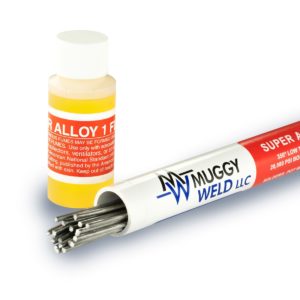
Super Alloy 1 Pot Metal Solder and Multi-Metal Solder
$69.00 – $109.00350º F multi-metal solder joins pot metal and all white metals, in any combination🌡 Melting Temperature 350 / 177 ⇄︎ Bonding Strength 20000 psi, 137.89 MPa -
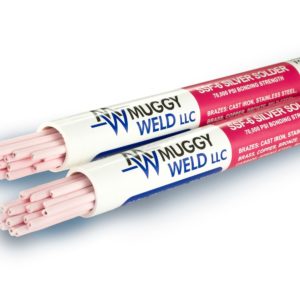
Silver Solder Rod: Flux-Coated SSF-6 56% Brazing Rod
$69.00 – $260.00High-Strength, 56% Silver Solder Rod🌡 Melting Temperature 1150 / 621 ⇄︎ Bonding Strength 70000 psi, 482.63 MPa 🔧︎ Sizes Available (in) 1/16 🔧︎ Sizes Available (mm) 1.58 -
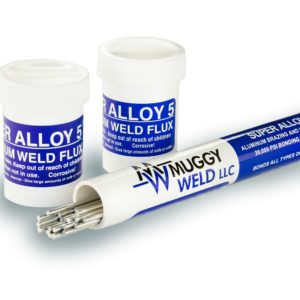
Super Alloy 5 Aluminum Welding and Brazing Rod
$69.00 – $109.00600°F aluminum welding, brazing, and soldering rod. Ideal for aluminum boat repair and cast aluminum.🌡 Melting Temperature 600 / 317 ⇄︎ Bonding Strength 30000 psi, 206.84 MPa