
Muggy Weld customer Robert Freeman sent the following testimonial regarding our 75 cast iron welding rods for nodular, malleable, and ductile cast iron welding:
Hey Muggyweld.com, I used the 75 to weld back the steering arm on the spindle of a Kubota 4 wheel drive tractor with a front end loader (also a Kubota)
Robert noted that the man he prepared the weld for “defines work environment, he’ll pressure test it to the limit”
and after returning the Kubota to his customer, followed up with
Attached are the before and after photos of the tractor steering arm weld with 75 welding rods. Super impressed. My customer just called and said he had used the front end loader, disc and bush hog all day today. Thanks! Robert Freeman
When it comes time to weld cast iron, most welders will take a pass on this dirty, porous foe. Other welders have been known to grab whichever cast iron electrode they have handy in their shop, crossing their fingers hoping for a positive outcome. At Muggy Weld, we receive calls from customers stating they’ve used stainless steel rod, MIG wire, or 7018 before and for some reason, it isn’t working for their current application. Incorrectly identifying the type of cast iron is often the issue.
Before running a bead, you first need to identify which type of cast iron you’ll be welding. If you’re unsure which type of cast you’re about to weld, one determination test used is the ring test. Gray cast will not produce a ring sound, but ductile cast will. The chisel test will also help identify whether the cast iron is gray or ductile–gray cast creates small chips like dust, while ductile will try to curl.
Ductile cast is often used in agricultural tractors due to its strength, durability, impact resistance and wear resistance. Ductile iron is known as functional industrial iron because it bends before it breaks, unlike brittle gray cast iron. An iron that possesses attributes such as these needs to be paired with an equally impressive cast iron welding rod.
75 cast iron welding rods from MuggyWeld.com are engineered to hold up to durable ductile iron. Ductile cast iron is used in some nasty outdoor environments which can cause the metal to become heavily contaminated–75 cast iron welding rod has the unique ability to penetrate these surface contaminates.
If you are working on clean ductile or malleable castings, 75 cast iron welding rods can also be used as a TIG weld rod.
Thanks, Robert, for sharing your success using Muggy Weld’s 75 cast iron electrode to weld this Kubota tractor steering arm.
Disclaimers:
Please visit https://www.aws.org/Standards-and-Publications/Free-Resources/#YourResources prior to using Muggy Weld products, and adhere to all AWS welding safety guidelines.
Further product safety information is available at http://muggyweld.com/safety-guidelines
Muggy Weld LLC shall not be liable for any loss, injury, claim, liability, or damage of any kind resulting in any way from (a) your use of this Site, (b) any services or products obtained from this Site, (c) any errors in or omissions from this Site, (d) the unavailability or interruption of this Site or any features thereof, (e) any content contained on this Site.
MSDS sheets available with purchase from MuggyWeld.com, upon request.
Check Out These Products
-
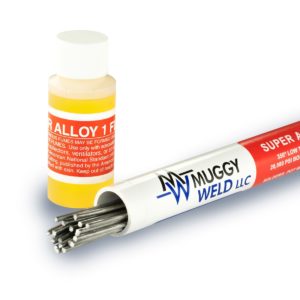
Super Alloy 1 Pot Metal Solder and Multi-Metal Solder
$69.00 – $109.00350º F multi-metal solder joins pot metal and all white metals, in any combination🌡 Melting Temperature 350 / 177 ⇄︎ Bonding Strength 20000 psi, 137.89 MPa -
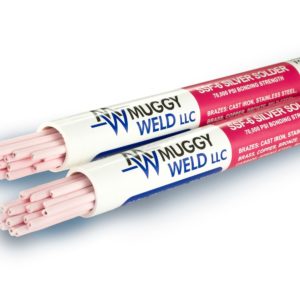
SSF-6 Silver Solder Rod: Flux-Coated SSF-6 56% Brazing Rod
$69.00 – $260.00High-Strength, 56% Silver Solder Rod🌡 Melting Temperature 1150 / 621 ⇄︎ Bonding Strength 70000 psi, 482.63 MPa 🔧︎ Sizes Available (in) 1/16 🔧︎ Sizes Available (mm) 1.58 -
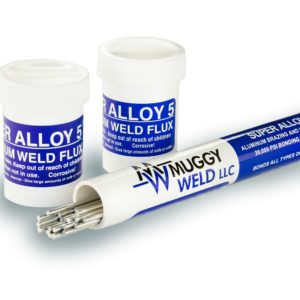
Super Alloy 5 Aluminum Welding and Brazing Rod
$69.00 – $109.00600°F aluminum welding, brazing, and soldering rod. Ideal for aluminum boat repair and cast aluminum.🌡 Melting Temperature 600 / 317 ⇄︎ Bonding Strength 30000 psi, 206.84 MPa