
Cast Iron

Aluminum

Pot Metal

Steel

Stainless Steel

Copper Brass & Bronze

Heat Dissipation

Prices/Order Info


All Products

Home   |   Prices/Order Info   |   Watch Videos   |   Site Map   |   FAQ   |   Email

77 & 72 Electrodes

77/72 Comparison

Compare 77 Electrode 72 Electrode
Sizes available 5/32", 3/32", 1/8" 5/32", 3/32", 1/8"
Arc - TIG - Braze Arc - TIG Arc - TIG
Works on engine blocks Yes Yes
Works on large cast iron holes Yes Yes
Joins cast iron to steel Yes Yes
Joins cast iron to metals other than steel No No
Works on exhaust manifolds, woodstoves, or other burnt cast iron Good Great
Works on thin cast iron Yes Yes
Color match? Fair Fair
All position? Yes Yes
Machineable? Yes No
Paintable? Yes Yes
Works over existing welds? Fair-- better on unwelded surface Fair
Depth to bevel cracks 3/4 through 3/4 through
Crack resistant? Yes No


72 Information

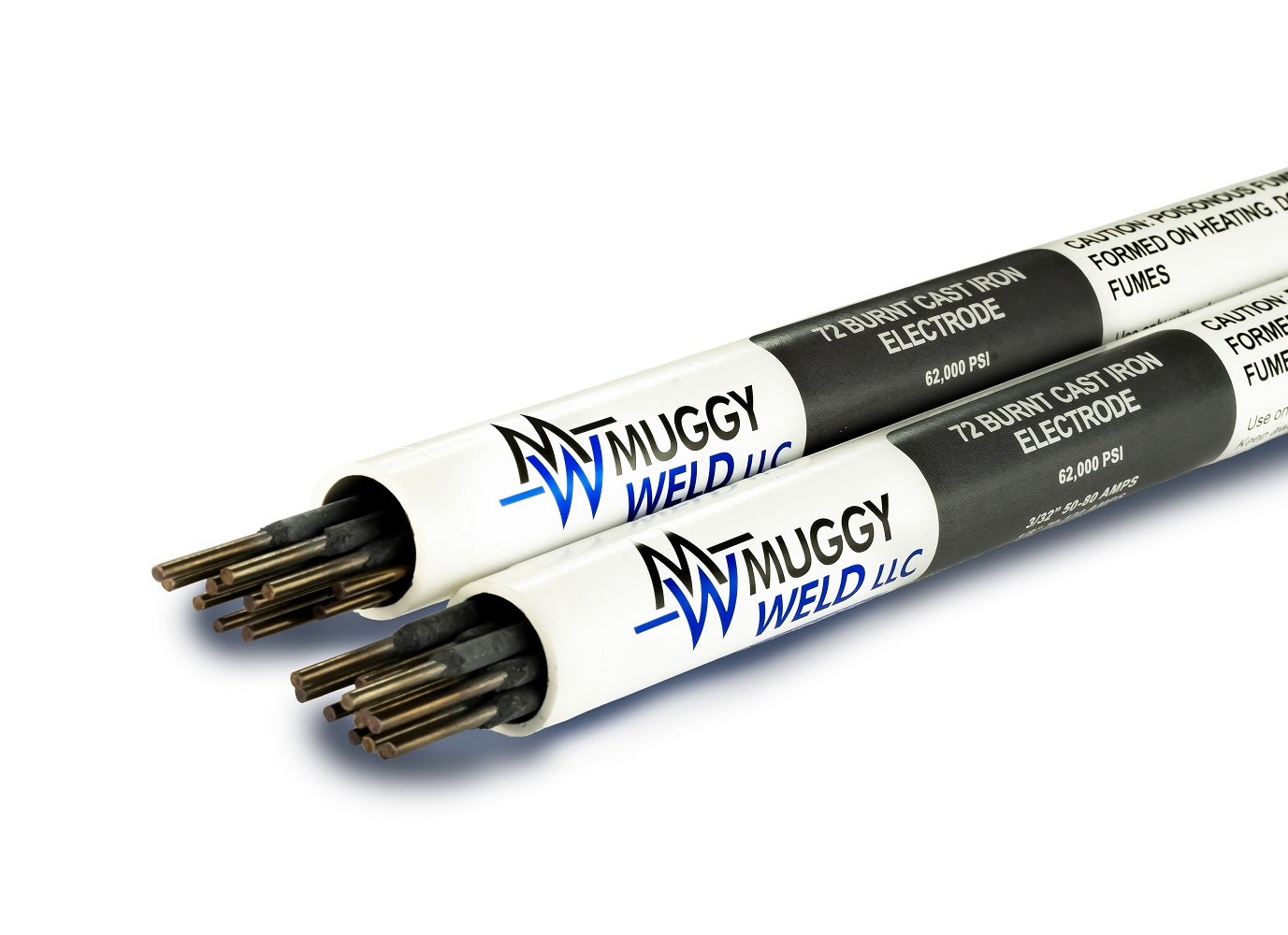
Available in 1/8", 5/32", 3/32"

There are occasions in industry where exceedingly dirty cast iron is encountered. 77, which bonds well to most cast iron does have a limitation. Since 77 has controlled penetration, which is ideal for non-cracking and machinability, it may not be able to bond exceptionally dirty cast iron. 72 should be used instead. It has a high penetration, can anchor deep into the subsurface of dirty cast iron, and seals in porosity generating contaminates prior to finish welding with 77. 72 is used for a cladding operation, then the weld is completed with 77.

72 is our recommendation for welding cast iron exhaust manifolds.


Welding positions: flat, vertical (up), horizontal, vertical (down), overhead

Welding techniques: Use stringer or moderate weave technique. When cladding, cover the entire base surface prior to finish welding.
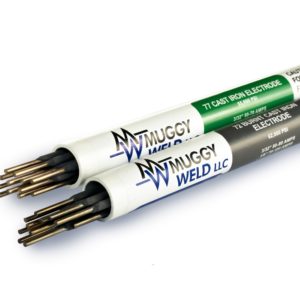
Applications: for non-machinable welds on exhaust manifolds, furnace grates, cast iron stoves, machine bases etc.

How to Apply

Begin by beveling the joint. Drill holes 1/2" from each end of the crack to prevent further cracking while welding. Tack weld to retain alignment. Use AC or DC with reverse polarity. (70-110 amps for 1/8" rods, 95-140 amps for 5/32" rods) Maintain a short to medium arc and make short passes and peen each pass promptly to chip off slag before cooling. Continue back whipping and overlapping until all deposits are connected. Cool naturally.

77 Information

Available in 1/8", 5/32", 3/32"


Tensile (as welded): 52,500 - 55,000 PSI
Tensile (slightly worked): 56,100 - 58,250 PSI
Elongation (in red zone): 71%
Elongation (in weld room temp. 70): 59%
Yield (as welded): 44,550 PSI
Yield (slightly worked): 45,750 PSI
Color match (Grey Iron): Good
Machinability: Excellent
Weld Appearance: Excellent
Weldability: Excellent


Cross Strength (Build up area) * Points
(In total Sq. Ins. Area) Thickness 100 Index
8 sq. ins. 1/4" 90
16 sq ins. 3/8" 88
32 sq ins. 1/2" 87
64 sq ins. 1-1/2" 84


How to Apply

Begin by beveling the joint. Drill holes 1/2" from each end of the crack to prevent further cracking while welding. Tack weld to retain alignment. Use AC or DC with reverse polarity. (60-110 amps for 1/8" rods, 90-140 amps for 5/32" rods) Maintain a short to medium arc and make short passes and peen each pass promptly to chip off slag before cooling. Continue back whipping and overlapping until all deposits are connected. Cool naturally.

Cast Iron
Videos
Ornamental Fireplace Stand Repair        (1:46)
Cast Iron Blower Repair        (2:23)
Cummins Exhaust Manifold Repair with 72 & 77        (3:45)
Articles
Lincoln Water Pump Repair
Exhaust Manifold Repair with 72 & 77
Cast Iron Engine Block Repair with 77
Cast Iron Backhoe Repair with 77


Clients | Testimonials | Links | Interesting Information


© 1998-2010 Muggy Weld
The content of this website is copyrighted. No usage of ANY content of this website without written consent of MuggyWeld.com.